
After the Forrest Fire
The Arena, the Shadow, and Why I Still Believe in Nuance

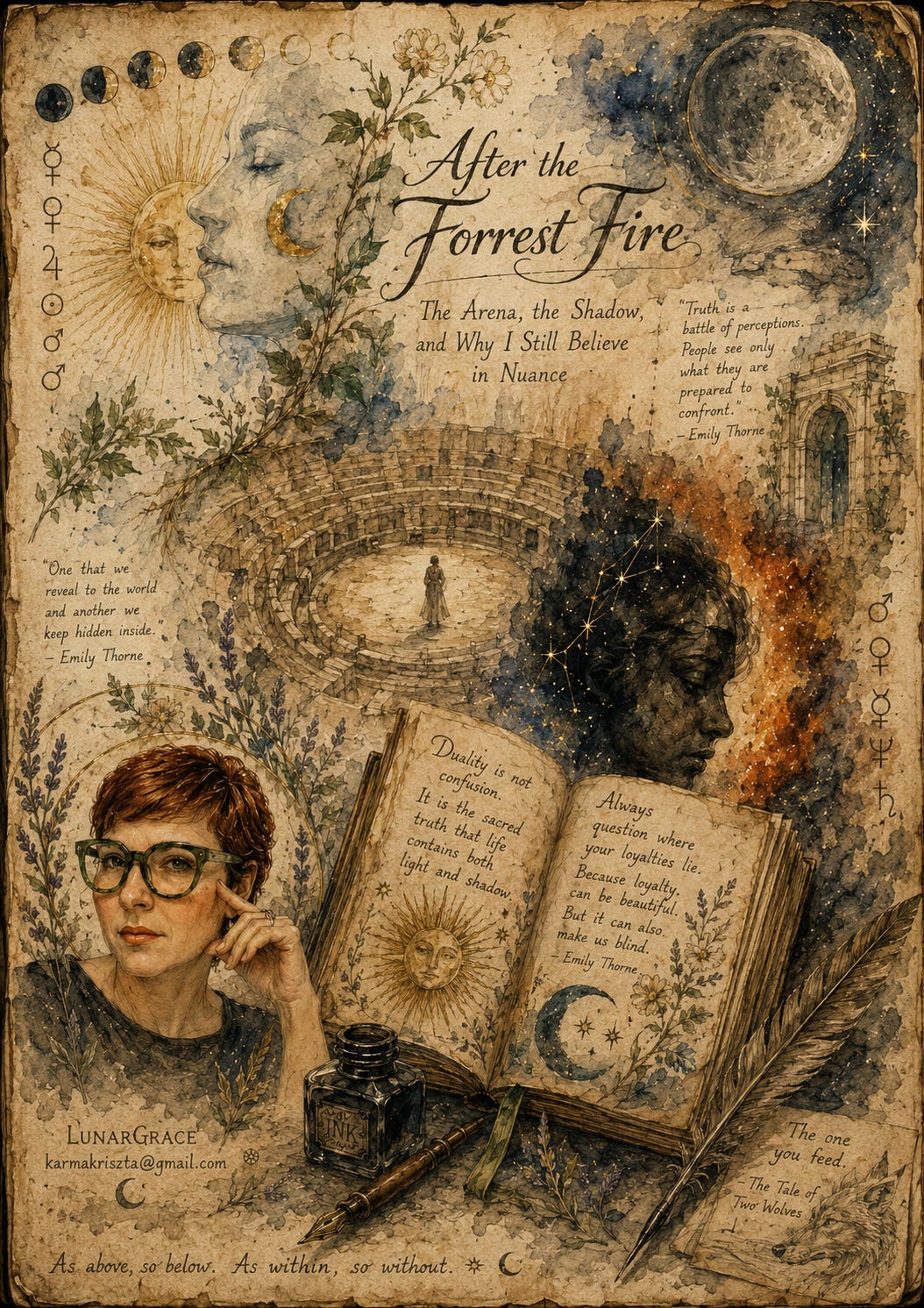
I honestly did not expect my thoughts about Steven Forrest and what happened in our astrology community to travel as far as they did. I wrote the first article because I was disturbed by the entire situation, because writing is how I process what I cannot immediately make sense of, and because something about the way all of us were behaving would not leave me alone. Then suddenly the article was being shared, reposted, and discussed in places I was not even part of, and my timid Pisces Sun started thinking, oh shit, perhaps I should have stayed quietly in my little corner with my books.
I was surprised by how many beautiful messages I received from people who understood exactly what I was trying to say. Some told me the piece helped them reconcile their own conflicting feelings. Others said it reminded them that accountability and compassion do not have to cancel each other out. And then, of course, came criticism, because if you walk into the arena, you cannot demand that everybody in the audience clap.
And yes, before somebody says it again, the article was long. Very long. It was not written for somebody who wants a thirty-second answer while scrolling between six other things. I love long-form writing. I like following a thought until I discover where the damn thing is taking me. My Mercury in Aquarius in the 3rd house trine Pluto was probably never going to be satisfied with three paragraphs and a heart emoji. I love talking, investigating, researching, connecting psychology with astrology, history with behavior, mythology with politics, and then disappearing down a rabbit hole until somebody in my family asks whether I am ever planning to come back.
Writing is deeply personal to me because when I first came to the United States, people made fun of my Hungarian accent. Strangely enough, the people who found my accent funniest were usually people who spoke exactly one language. Apparently speaking multiple languages becomes hilarious when you pronounce one word imperfectly. Life has a sense of humor like that.
For a long time, I became self-conscious about speaking. Writing gave me another kind of freedom. Nobody hears my accent on the page. I can go back. I can edit. I can sit with a sentence and replace the word that came out wrong with the word I actually meant. My Pisces Sun can disappear into writing and live there for hours. I can relive people I loved and memories I never want to lose. I can recreate beautiful moments. I can escape into characters who behave exactly the way I wish human beings behaved, which is terribly convenient because actual human beings remain stubbornly committed to free will. And when somebody really pisses me off, I can become the Punisher, or perhaps Orcus, for an afternoon and right every wrong on paper. Nobody gets arrested, nobody needs a lawyer, and somehow I feel much better afterward.
Writing is oxygen to me.
And you guys know I always say I am Queen of the Quotes, not Queen of the South. Although my Sagittarius rising ego occasionally applies for both positions. One of the quotes I have carried with me for years comes from Theodore Roosevelt’s Man in the Arena. Roosevelt describes the person whose face is marked by dust, sweat and blood, the person who actually strives, fails, gets back up and tries again. The line I always return to is that “the credit belongs to the man who is actually in the arena.”
That quote became especially personal after being mocked for my accent. The people laughing were not in my arena. They had not moved across an ocean. They had not begun an adult life in another language. They had not raised children between cultures or tried to build a professional voice in a country that was not the country that formed them. It is very easy to judge somebody’s pronunciation from behind a keyboard when you have never tried to build an entire life in somebody else’s language.
The arena feels different.
So yes, when a few responses to my Forrest piece came in, they poked my Sagittarius-rising ego directly in the ribs.
One criticism was that my article was trying to hold “all the perspectives,” as though that meant I was afraid to decide what I believed.
But that was not an accident in the article.
That was the entire point.
I was talking about duality.
We astrologers spend our lives studying polarity. Aries and Libra. Taurus and Scorpio. Gemini and Sagittarius. Cancer and Capricorn. Leo and Aquarius. Virgo and Pisces. Sun and Moon. Mars and Venus. Saturn and Jupiter. Creation and destruction. Conscious and unconscious. Light and shadow. We examine an axis because one side becomes meaningful partly through its relationship with the other.
If you had never tasted bitter, how would you recognize sweet? If there were no darkness, what would light even mean? If we had never experienced grief, would love carry the same weight?
That does not mean every side of every argument is morally equal. Nuance does not require false equivalence. Racism, prejudice, power and historical inequality are real, and we should be intelligent enough to distinguish those things rather than throwing everything into one convenient philosophical blender.
But human beings are complicated. Two truths can coexist. Sometimes six truths can coexist, which is terribly inconvenient when social media would prefer a thumbs-up or an angry face.
That is why one of my favorite quotes from Revenge has always been Emily Thorne talking about the two sides of every story and the two sides of every person, “one that we reveal to the world and another we keep hidden inside.” The larger idea is about the balance between light and darkness and the capacity for both living within each of us.
I loved that long before this controversy because astrology has taught me essentially the same thing. We examine the shadow not because we worship darkness, but because denying its existence gives it extraordinary power. The shadow we refuse to acknowledge does not disappear. It simply becomes better at operating without our supervision.
This was also why I mentioned Jesus and Buddha in my original article, and apparently that was the exit ramp for a few readers. Somebody essentially said the minute people start mentioning God or Buddha, they are out.
I found that fascinating.
We are astrologers. We discuss Zeus, Saturn, Pluto, Persephone, Prometheus, Egyptian deities, karma, reincarnation, ancient mystery traditions, archetypes, gods and goddesses. But I mention Jesus and Buddha while talking about compassion and suddenly somebody needs an emergency evacuation plan?
I was not asking anyone to become Christian. I was not asking anyone to become Buddhist. I was talking about teachings. Compassion. Forgiveness. Mercy. Service. Self-examination. The uncomfortable distance between the spiritual values we advertise and the ones we manage to practice when somebody truly pisses us off.
I came from Catholicism and later found Nichiren Buddhism. I have never needed one tradition to destroy the other in order for me to learn something from both. If Jesus teaches something about forgiveness that challenges me, I listen. If Buddhist teachings about suffering, attachment or compassion challenge me, I listen. Somebody else may find wisdom somewhere completely different. Beautiful.
What troubles me is how many of us claim spirituality while behaving as though compassion is only required toward people we already like.
What is spirituality worth if it disappears the moment somebody offends us?
Another Emily Thorne thought I love is that truth can become a battle of perceptions, because people often see only what they are prepared to confront. That is exactly what I felt watching this entire situation. Everybody was looking at the same fire from a different window and becoming increasingly convinced that the view from their particular window was the entire building.
None of this means anger is unspiritual. Quite the opposite. I specifically wrote about Mars because anger has a purpose. Mars protects. Mars separates. Mars says no. Mars fights when something valuable is being violated. People who were hurt had every right to be angry. And believe me, I have Mars exalted in Capricorn. I do not need a beginner’s course in anger. I know Mars very well.
But anyone who studies astrology also knows that every archetype has a shadow. Courage can become aggression. Protection can become retaliation. Justice can become vengeance. Anger can begin by defending somebody’s humanity and end five minutes later by forgetting somebody else’s.
Compassion has a shadow too. Compassion without boundaries can become enabling. Forgiveness demanded too early can become another form of violence. Pisces without Mars can sacrifice itself into oblivion just as easily as Mars without compassion can destroy everything in the room.
That was the conversation I wanted.
It was never the “niceness Olympics.”
I was not asking everyone to use the same tone. I was not asking Black astrologers who have lived with racism for decades to perform perfect politeness while discussing something painful. I was asking what happens after anger enters the room. What do we do with it? Does it remain purposeful? Does it challenge the behavior and demand accountability? Or does it eventually become humiliation, mockery, appearance-shaming and the strange public pleasure of watching somebody burn?
One of the most meaningful responses to my article actually came from Samuel Reynolds himself. I had mentioned that he called people who unfriended him “trash.” Sam later reflected publicly on that choice of language. He explained the anger underneath it, but he also acknowledged that people do not become trash simply because we despise something they said or did. He did not pretend his anger had been illegitimate. He examined what he chose to do with it.
That, to me, was the silver lining.
That is growth.
Not perfection. Growth.
Growth is rarely beautiful while it is happening. Usually it is messy and embarrassing and involves realizing that a sentence we defended yesterday might not be a sentence we would choose today. That takes more strength than deleting everything and pretending we never said it.
And then another comment arrived that genuinely stunned me.
A woman who openly admitted that she had not finished my article nevertheless apparently managed to understand my entire personality well enough to announce that I was “the type of person that comes to New Orleans for plantation vacations.”
She described herself as a Black Louisiana native and essentially suggested that because of where she came from and what she had experienced, she already knew “my type.”
That sentence stopped me.
Not because she disagreed with me. Disagree with me all day long. That is part of being in the arena. But think about the logic for a second. A woman who had never met me, who had not even finished what I wrote, looked at a white Hungarian immigrant she knew virtually nothing about and decided that my race and the fact that I had visited a plantation were enough information to construct my character.
And somehow this was happening in a conversation about prejudice.
The irony was almost too perfect.
People argue endlessly about the phrase “reverse racism,” and I actually think the terminology can distract us from the more intelligent conversation. Structural racism and interpersonal prejudice are not identical things. History, power and institutions matter. I am not going to pretend that one insulting Facebook comment directed toward a white woman carries the same historical weight as centuries of systemic racism against Black people. It does not.
But prejudice does not magically become insight because the target happens to be white.
Judging somebody’s morality, motives or character from their skin color is still an assumption based on race. If our goal is to become more conscious about prejudice, then surely consciousness cannot mean examining everybody’s stereotypes except our own.
And here again is the duality.
I can acknowledge that I have never lived the experience of a Black woman in Louisiana. I cannot know what she has experienced, what racism she has witnessed, what her family history contains or why seeing tourists at plantations may bring up anger, pain or disgust for her. I can respect that reality.
And at exactly the same time, she does not know my story either.
She does not know what kind of mother I am. She does not know why we traveled to New Orleans. She does not know what I taught my children. She does not know the conversations we had afterward. She does not know that when my family travels, we deliberately seek out history because I do not want my children growing up inside a sanitized version of the world.
Both realities can exist.
Again, duality.
No, we did not go to New Orleans for a “plantation vacation.” We visited a historical plantation because my family visits historical sites when we travel. We go to museums, memorials, battlefields, old cities and places where beautiful history happened, as well as places where horrific history happened. I took my children there specifically because I wanted them to learn about slavery, not as an abstract paragraph in a textbook but standing on the actual ground where human beings lived, suffered, worked, loved, resisted and died.
I wanted my children to ask questions. I wanted them to feel uncomfortable. I wanted them to understand that slavery was not simply a sentence between the Revolutionary War and the Civil War that they needed to memorize for a test. It happened to actual people. Mothers had children taken from them. Families were separated. Human beings were bought and sold. Generations lived with consequences that did not magically disappear when somebody signed a document.
Why on earth would I not want my children to know that?
Especially now, when the way race, slavery, inequality and American history are taught has itself become a political battlefield. That makes me more determined to teach my children history, not less. Whatever political party is in power, I do not want my children’s understanding of the past to depend entirely on which governor, president, school board or textbook publisher happens to be making decisions that year.
History happened.
We do not protect children by pretending the ugliest parts did not happen. We protect the future by teaching them what human beings are capable of when another group is declared less worthy, less intelligent, less human or simply different enough that cruelty becomes acceptable. Bob Marley’s message in War was essentially that as long as one race is treated as superior to another, conflict remains with us.
Isn’t that exactly the lesson we are supposedly trying to learn from racism?
So what would have been more virtuous? Should I have taken my children only to Bourbon Street and skipped the plantation because slavery was too uncomfortable? Should I tell my children, “This history involved white people enslaving and brutalizing Black people, so because you are white, perhaps you should avoid looking at it too closely”?
Of course not.
That would be absurd.
Education is not guilt, and history is not inherited personal shame. Learning what people who shared your skin color in this incarnation once did does not mean you personally committed their crimes. It means you have the opportunity to understand what happened, recognize how human beings became capable of it, and hopefully never repeat that blindness.
That is exactly what I wanted my children to understand.
And this is precisely why I resist reducing souls to categories. In my own karmic worldview, I happened to be born into this incarnation as a white Hungarian woman, but if reincarnation is real, then across hundreds of lifetimes perhaps all of us have been white, Black, Asian, male, female, straight, gay, powerful, powerless, privileged, persecuted, the one who belonged and the one who was pushed outside. And sometimes I wonder about that. What if I felt strangely called to stand on that plantation because somewhere in the long memory of the soul I had once stood on similar ground as the person who suffered the injustice rather than the person who benefited from it? Maybe. Maybe not. I cannot possibly know. But just allowing that possibility changes the way I look at another human being. It becomes much harder to believe that the skin, gender, nationality or sexuality someone carries in this one lifetime tells me the whole story of their soul. Just think about that for a moment.
Maybe this is where the shadow gets really uncomfortable, because prejudice is incredibly easy to recognize when somebody else is doing it.
Our own prejudice usually arrives wearing the costume of certainty.
We tell ourselves, “I know this type.”
That sentence should scare us a little.
Because no, you do not know me, miss.
And I do not know you either.
That is the point.
I am not claiming that visiting a plantation earns me a medal for understanding racism. Please.
But going there with respect, listening, learning and teaching my children was not entertainment to me.
It was education.
And I will continue taking them to places where history becomes uncomfortable because I do not believe discomfort is a reason to stop learning.
Maybe this is also where loyalty becomes interesting. Another Emily Thorne quote I have always loved begins, “Always question where your loyalties lie.” Loyalty can be beautiful. Loyalty to people, teachers, movements, communities and beliefs. But loyalty can also make us blind.
That was part of the Forrest Fire too.
What happens when somebody we admire disappoints us? Do we defend everything because we love the teacher? Do we destroy everything because we hate the mistake? Can we say, “This was utterly wrong,” without deleting thirty years of somebody’s life?
Those questions are uncomfortable because they do not give us the emotional satisfaction of a perfectly clean villain and a perfectly clean hero.
And somewhere in reading all those comments, I caught my own shadow too.
My first impulse was Mars. My Sagittarius rising wanted a podium. My Mercury wanted documentation. My Pluto wanted to conduct a forensic investigation complete with evidence bags. Eventually my Pisces Sun wandered into the room and escaped again into writing.
That is my own duality.
I am not standing outside this lesson pointing at everybody else. I am in it.
I can preach compassion and still become furious when somebody misunderstands me. I can write an entire article about not reducing people to their worst moment and then immediately feel tempted to reduce somebody to the ignorant comment they made about me.
There is my shadow.
There is the lesson.
I do not believe nuance is cowardice. I do not believe compassion means refusing to distinguish right from wrong. I do not believe understanding somebody means excusing them. And I certainly do not believe anger automatically becomes wisdom simply because the anger itself is justified.
Maybe the silver lining is simply that the astrology community was forced to look at itself. At racism, prejudice, language, anger, leadership, loyalty, deplatforming, forgiveness, hypocrisy, spiritual identity, our relationships with teachers, what happens when our heroes disappoint us, and what happens when accountability itself begins turning into entertainment.
Maybe we needed to ask whether we actually practice the compassion we put in our biographies.
Astrology has never promised that human beings are creatures of pure light. Every chart contains tension. Every archetype contains expression and shadow. Every planet can build something and distort something.
As above, so below. As within, so without.
Perhaps maturity is not choosing the light and convincing ourselves that darkness belongs exclusively to somebody else. Perhaps maturity is recognizing both when they appear inside us and becoming conscious enough to decide which one we feed.
That brings me to the old story often called The Tale of Two Wolves. An elder tells a child that two wolves are fighting inside every human being. One carries anger, envy, arrogance, resentment, lies, superiority and ego. The other carries joy, peace, love, humility, empathy, generosity, truth, compassion and faith. When the child asks which wolf wins, the answer is simple:
The one you feed.
I think about that a lot.
Because none of us gets to claim we have only one wolf.
That would be another form of denial.
The work is noticing which one has been eating very well lately.
And that brings me right back to Roosevelt and the arena.
The critic in the stands usually has clean clothes. The person actually trying to speak, apologize, learn, change, forgive, repair or understand is probably going to end up covered in dust, sweat and occasionally embarrassment.
Fine.
I would still rather be in the arena.
My accent included.
Thank you SO much! You have such an amazing voice and 360 degree perspective. I appreciate these posts so much. Never silence your beauty.
I have read both the articles you have written about this topic and I have so valued you words. I am really grateful you had the courage to write.