
Pretend -segment

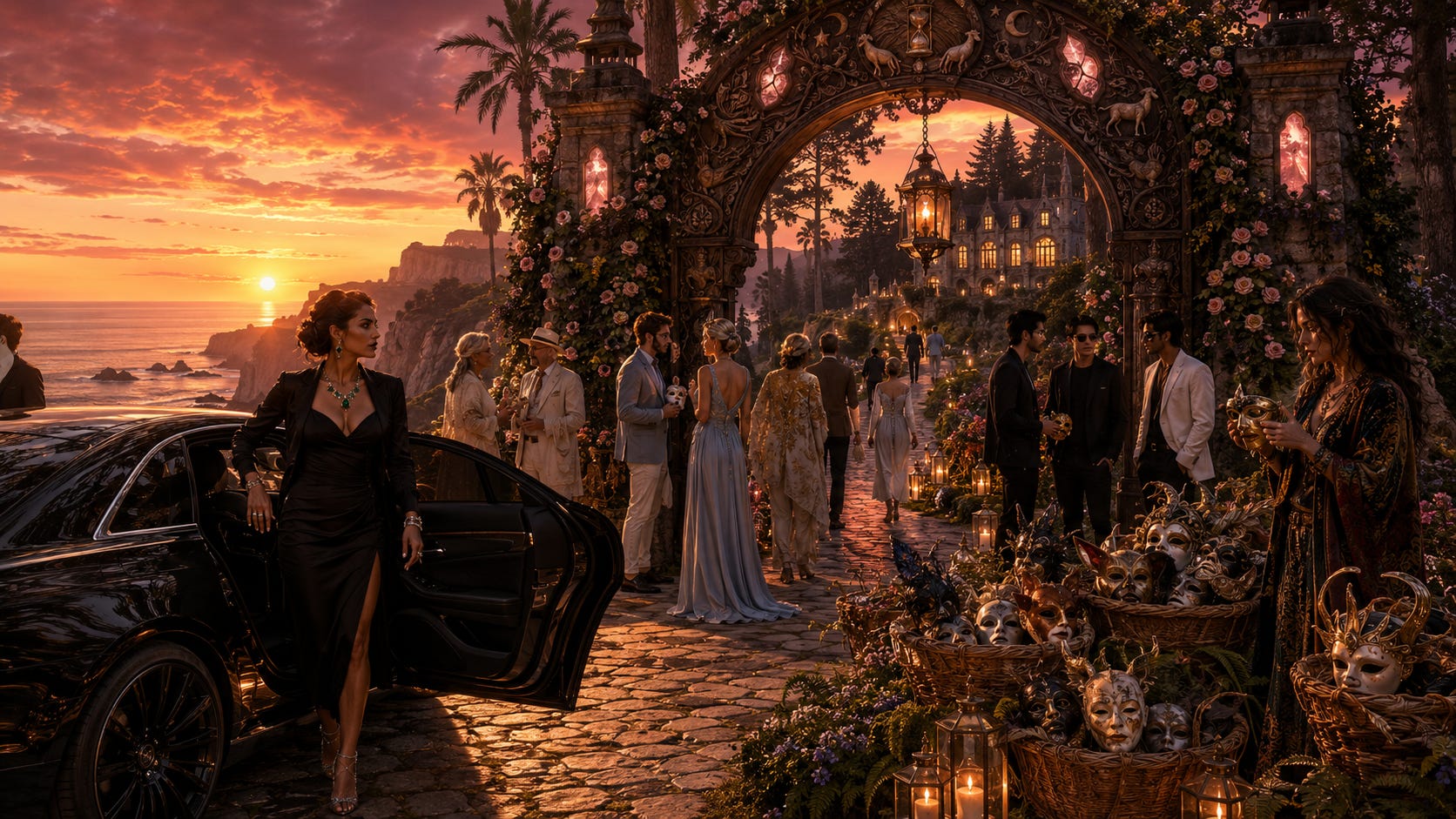
A Maserati rolls up next, deep black, polished so perfectly it reflects the orange sunset like wet glass.
A woman steps out slowly, one diamond heel touching the stone path before the rest of her follows. She is dressed head to toe in wealth that knows its own name: Gucci sunglasses pushed into her hair, a Louis Vuitton clutch tucked under one arm, Prada heels, Cartier on her wrist, emeralds at her throat, diamonds sharp enough to start an argument.
Her black dress is tailored to perfection. Her red lipstick does not move. Her perfume arrives in layers: rose, leather, expensive smoke, and something sweet underneath, like a memory she tried to bury.
At first glance, she looks untouchable.
Then she turns her head, and the cowgirl still shows.
Not in the clothes. Never there.
In the way she plants her feet. In the way she scans the land before the people. In the way her eyes measure danger before beauty. She came from a poor, abusive home where survival had dirt under its nails and nobody handed you softness for free. Now she wears Gucci like armor, Louis Vuitton like a shield, diamonds like proof that the past did not swallow her whole.
She looks around Uma’s estate and immediately decides who matters, who is useful, who is dangerous, and who can be ignored.
Old poverty taught her hunger.
New money taught her about performance, but she’s still a poor cowgirl dressed in Gucci.
The financial differences are clear before anyone speaks.
Some guests wear silk that moves like water. Some wear suits cut so perfectly they seem born on their bodies. Some wear family jewelry, the kind passed down through generations with blood and secrets attached. Others wear borrowed gowns, rented tuxedos, polished shoes with thin soles, dresses altered by hand, ambition dressed as elegance.
There are perfumes too.
Oud and amber. Rose and sandalwood. Violet and tobacco. Citrus, musk, vanilla, jasmine, expensive soap, nervous sweat, sea salt, leather, champagne, and the faint green smell of crushed wildflowers under beautiful shoes.
A group of old-money guests moves slowly up the path, laughing in low voices. Their clothes are pale, cream, champagne, pearl, soft blue, and gold. Their masks are carried in velvet pouches by assistants. They do not look around in amazement. They look around in assessment.
Behind them, a cluster of younger tech men arrive in minimalist black, gray, and white clothing so casual it becomes another way of announcing power. No ties. No visible effort. Watches worth more than cars. Shoes clean enough to have never met the weather. They speak quietly about markets, platforms, exits, and regulatory risk while walking through a meadow full of deer, which feels like a crime against poetry.
The artists arrive differently.
One woman carries a stained canvas bag and wears a silk scarf tied around her head. Her dress is orange, loose, and alive in the wind. A man beside her wears rings on nearly every finger and smells of cedar, paint, and cigarettes. They stop to admire the wildflowers, the birds, the lanterns, the strange mix of fruit trees. They understand immediately that the path is not decoration. It is a spell.
Near the rose-quartz gate, guests slow down.
Everyone does.
The giant wooden arch rises before them, carved with vines, moons, stars, serpents, lions, birds, and tiny hidden eyes. Rose-quartz windows glow inside the wood, catching the sunset and turning the entrance pink, gold, and soft red. The craftsmanship is old and exact. The gate does not look built. It looks summoned.
Beyond it, Uma’s house waits on the cliff.
Stone walls warmed by the sunset. Tall windows shining with golden light. Gardens spilling toward the sea. The ocean behind it, wide and burning. The forest behind that, dark and green. Mountains in the distance, already turning purple.
For a moment, even the cruel guests become quiet.
Because the place is too beautiful to insult immediately.
Then someone laughs.
Someone checks their lipstick.
Someone adjusts a cufflink.
Someone takes a photo.
Someone whispers, “Who lives like this?”
And the answer moves through the trees, the flowers, the sea, and the glowing path.
The entrance is a massive wooden arch, wide enough for carriages, horses, limousines, and all the egos that arrive pretending they are not fragile.
It rises from two stone pillars covered in climbing roses, ivy, and pale green moss. The wood is dark oak, aged and polished by time, rain, salt air, and careful hands. It does not look newly built. It looks as if it were inherited from another century, then lovingly restored by someone with money, patience, and taste.
Rose-quartz windows are set into the arch like soft pink jewels. As the sunset hits them, they glow from within, filling the entrance with a warm blush of gold, rose, and honey-colored light. The glow spills across the stone path and touches the guests’ shoes before they even enter, as if the estate is quietly reading them from the ground up.
The craftsmanship is extraordinary.
Branches twist through the wood as if the arch itself once grew from living roots. Along the upper beam, moths unfold their wings beneath a scattering of constellations, symbols of transformation, instinct, and the strange courage required to follow light through darkness.
On one side, a stag stands among ferns, watchful and dignified, its antlers branching like a sacred tree. On the other, a fox slips through wild herbs and bell-shaped flowers, clever, quiet, and impossible to possess. Small owls peer from hidden hollows, while dragonflies and fireflies hover between the leaves like tiny messengers from another world.
Other carvings appear only when the light touches them properly: an hourglass, an open book, a lantern, a labyrinth, acorns, mushrooms, seashells, thistles, wheat, and a small boat carrying a single flame. Near the center, two hands cradle a luminous seed, suggesting that every beginning must first be protected in darkness.
Along the inner curve of the arch, a delicate celestial map winds through the grain. Planets, constellations, and wandering stars are linked by fine carved lines, almost like secret roads through the night sky. Nothing is loud or decorative merely for the sake of beauty. Every symbol feels intentional, as though the arch remembers stories that were never written down and reveals them only to those patient enough to look twice.
Above the center hangs a copper lantern, shaped like a small temple, its glass panels etched with stars. Beneath it, the entrance casts a patterned shadow across the walkway, roses, moons, serpents, and birds spreading over the stones like a spell.
It is not just a gate.
It is a threshold.
The kind of entrance that makes people straighten their shoulders, adjust their jewelry, check their masks, and wonder, for one brief second, whether they should have stayed home.
Near the arch, ten elegant baskets overflow with masks.
Not carnival junk.
Art pieces.
One basket holds smooth porcelain masks, white as bone, edged in gold leaf.
Another holds velvet masks in emerald, wine-red, midnight blue, and black, stitched with pearls and seed beads.
A third basket holds carved wooden masks, dark walnut and pale birch, painted with suns, moons, crying eyes, and tiny constellations.
Another overflows with leather masks, soft and expensive, some plain and severe, others stamped with roses, thorns, and old alchemical symbols.
There are iron masks, heavy and brutal, with sharp noses and narrow eye slits.
There are papier-mâché masks painted in wild colors, glittering with cheap charm and hidden sadness.
There are diamond-studded masks that sparkle like they are trying too hard.
There are crude clay masks, cracked and earthy, still carrying the fingerprints of whoever shaped them.
There are masks covered in lapis, garnet, citrine, moonstone, obsidian, turquoise, and tiny emerald chips.
Some masks look holy.
Some look guilty.
Some look like they have been waiting for these guests for a very long time.
NARRATOR (V.O.)
Each mask was a choice. Hide. Reveal. Seduce. Survive. Perform.
GOVERNOR DIXON chooses a modest navy velvet mask with a thin gold border, the kind of mask that pretends humility was invited.
ANASTASIA KLINE selects a smoke-gray silk mask covered in tiny black crystals. Beautiful, sharp, cold.
DR. VINCENT ARAMIS reaches for a silver mask with diamond dust around the eyes. It looks surgical. Elegant. Unforgiving.
GREGOR MATHERS chooses a dark wooden mask carved with a third eye, because of course he does.
VERONICA SMITH picks a rose-gold mask with tiny pearls and a smile painted slightly too wide.
SABIR CHOWDHURY chooses a black leather mask stamped with golden vines, as if even nature should be owned.
FELIX MARONE picks a matte white mask with no expression at all.
ISABELLE VARNER hesitates, then chooses a pale blue papier-mâché mask with silver stars. Pretty. Fragile. Hopeful.
HARRIET “HURRICANE” JONES grabs a crimson mask edged with bronze spikes.
PASTOR DANIEL KIRK selects a cream-colored mask shaped like a saint’s face, with gold tears painted under both eyes.
KAI TANAKA takes a black-and-gold mask with one eye covered, one eye exposed.
SOFIA LORENZ chooses a delicate ivory mask dusted with moonstone powder, beautiful enough to make aging feel like a crime.
DJ ZARA KANE does not choose the prettiest mask. She chooses a wild black mask painted with electric-blue lightning, cracked silver stars, and one red mouth.
And HANNA?
Hanna walks past every basket.
No mask.
No apology.
NARRATOR (V.O.)
Some picked one. Some picked five. Some never realized they had arrived already wearing one.
❤️